
The Pacer
Being on top of the world ...

It took longer than expected to come back. It was also a long way back.
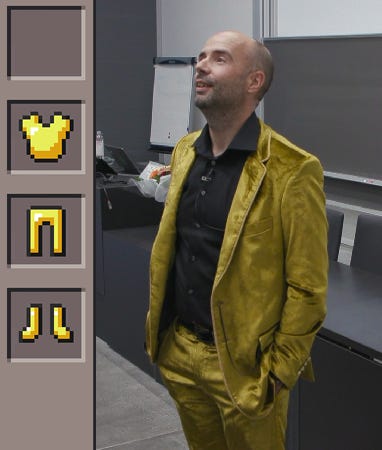
The last post on this substack was on March 15th. I guess for any observer, back then I should have been on top of the world: my most recent book, Playing Software, had just been released. I was also publishing other articles, finishing up the latest Ridiculous Software project, preparing panels with excellent people for DiGRA 2023, being invited to give keynotes and write chapters, heading the Center for Digital Play and most importantly, teaching a class of engaged students who were a delight to discuss with, teach, and learn from. And, I had just been made Full Professor of Digital Play. This may look like living a golden dream.
And yet, something was not working properly. My moods were shifty, swinging. I was not an easy person to be around, at work or at home. I couldn't sleep, couldn't plan ahead, and reacted more than acted.
I've had stress once before, so I knew what was coming, and I knew I was still on time to address things before it would become too bad. I am lucky to work at an institution that has learnt to address to these issues in a responsible manner, and to have the best colleagues, who understand and support and give what is necessary when it's needed.
So I pulled the plug. Not totally, I wasn't far down enough that I needed a total break. But I slowed down on some things: no travels, less writing commitments, less extracurricular activities. Less pushing myself out there, where there is actually nothing. If you haven't heard much from me, missed me on some events, or was wondering if this substack was dead, this is your answer.
Now, I am aware of my many privileges. I am a Full Professor, a cis man with something close to tenure in Academia. I have a voice, and people sometimes listen. Most others in my business are way worse off than I am. And yet all these privileges are worth nothing when the body decides everything is a bit too much.
Stress is a multifactorial disease. In my case, this time around, it happened because I was my own worst enemy. Academia is a lovely job, the best I can imagine. I can teach and write and think and try to listen to what the world needs now, what it may need in the future, and try to create knowledge that gets out there. Sometimes it works, sometimes it doesn't, but that's the point of being an academic.
At the same time, it is also a relentless job of perpetual self-doubt. We receive more rejections than praise. A central part of our job is supposed to be to critique the work of others. It is also implicit that we should carve our own niche, our position, and defend it. It is an agonistic job that it is too easy to turn into a zero sum game, where I win because the others lose.
This spectacle of competition has also become a public affair. We have citation indexes, and social media that acts as the loudspeaker of the narratives of the suffering academic. We publish, we share on social media. We get a grant, we make it a story. We get promoted, we update our socials. Not because we want to share, but because it is what is expected now.
For me, all of this translates into an inner pacer that relentlessly reacts to this stream of other people's successes by demanding more from me. My inner drive sees people succeeding and does not allow me to be happy for them. It demands that I do the same. My inner pacer stops thinking and listening and learning and just keeps pushing, keeps telling me to keep going, keep going, keep going. And then I break.
I am at my best when I don't listen to this pacer, when I find my rhythm and I don't play the battle royale game of academia. I thrive when I play this game as a team sport, and not as a solo competition. It has taken me time to learn to ignore the pacer, but sometimes it just takes over. But I have learnt to listen, so I slowed down. Talked to a therapist, and slowly tried to remember what makes me happy, which is what makes me a better person. And found support in my colleagues and my institution and my family. Because there is no way out on your own. It’s always a group effort.
I am now on the other side of my symptoms. Things are good and getting better, and I am back where my job is fun: writing what I think it's interesting, organising events, making weird stuff, teaching and learning again.
This substack will also return, but with a different format. Playing Software will not be a promotional vehicle for the book. I will write about it, as well as about other, future projects. But I will also write about whatever I find interesting. It will be regular, but not too regular. I will publish once a month, that's it. And it will be about what I want to write, and not what would be good for my brand, my career, or whatever else the pacer might want me to do.
Academia is too often a job that comes with a symptomatology. And it doesn't need to be so. Academia does not need to be the hunger games. We need to be better at it, we need to promote younger folks, celebrate new voices and support them, contribute with what we can and we want because we think it's important. We cannot avoid the relentless rhythms of modern academic environments, the measures and the numbers and the public sharin. But we can create pockets of sanity, of solidarity, spaces were thriving is not what happens after the next deadline, but everyday, when we meet up, when we dedicate time to think, to our students, to ourselves, and to others.
Really great post Miguel - I'm sorry you've had such a hard time lately, but thank you for sharing it with us: I always think "everyone else is doing fine, what are YOU so stressed about?!" to myself in my mind, and hearing that someone I greatly respect and admire has struggles too is comforting! <3